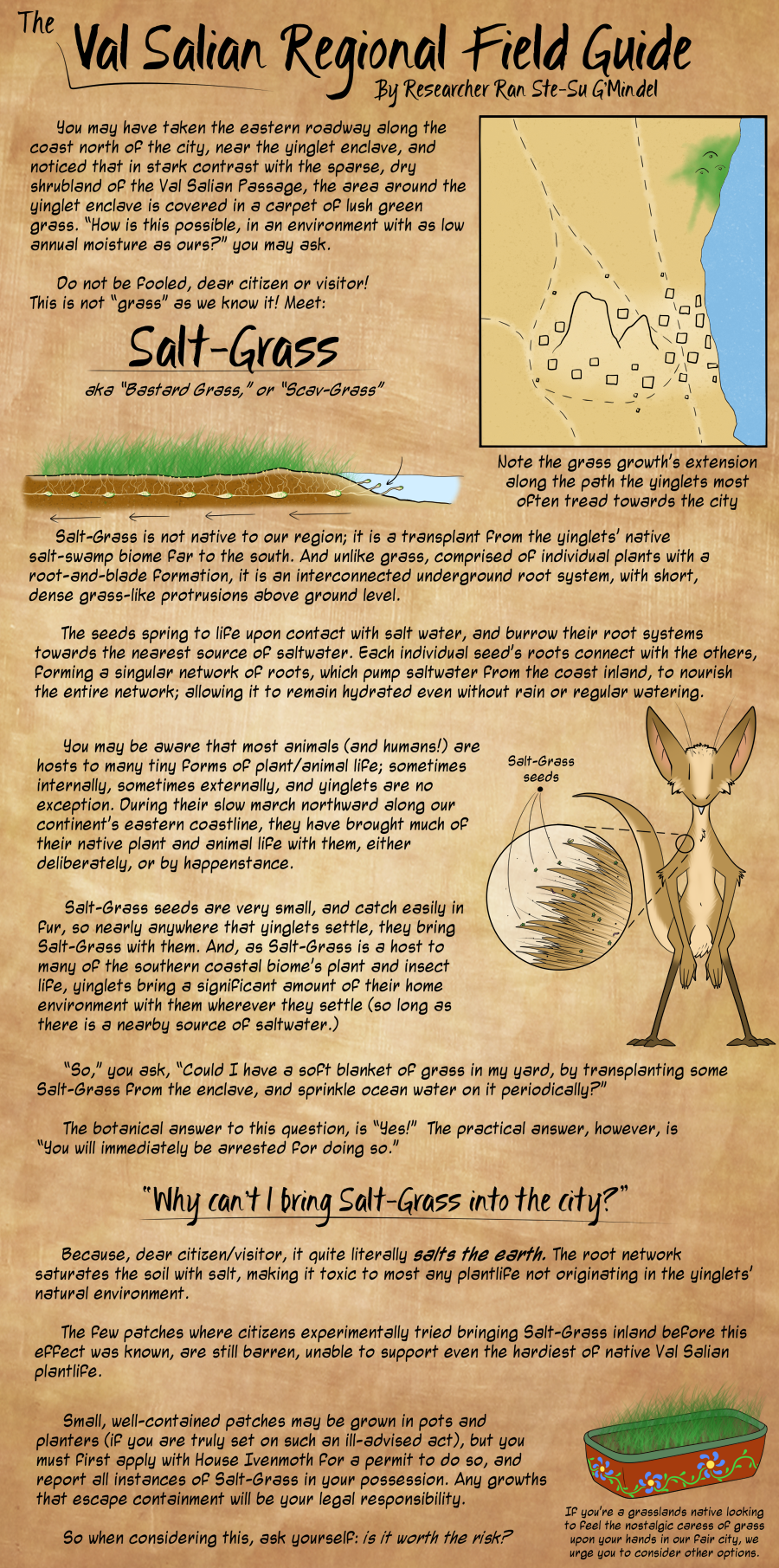
This is why you wash your yinglet before bringing it home
Out-of-Placers
A story of inconvenient changes
Support The OOPs


 OOPs now has a Russian translation which updates shortly after the English pages are posted!
Older RU pages: https://acomics.ru/~OutOfPlacers
Now also in French:

And Ukranian:







The common folk definitely regularly ask themselves such questions as “How is this possible, in an environment with as low annual moisture as ours?”, in exactly that class of language.
The thirsty seeds of salted grass
clinging cloyingly to clowders of scavs,
reforming lands to fill their needs,
quietly killing the quality of the soil.
Ohh, is so, so bad, but also is de easiest way to make foods salty, to add some dried salt grass to de recipe. Is why de humans tried to grow de stuff in de first place, and is one of our common trade goods zhat comes out of enclaves.
But if it requires saltwater to grow, why not skip the middle man and just harvest sea salt?
Perhaps the seawater has some undesirable substance in it that the saltgrass filters out?
Perhaps the saltgrass contains additional nutrients made by the plant, or tastes better?
Personally, I’d guess it’s mostly because picking some grass, rinsing it and drying it on a rack is much easier and faster than collecting, straining, and evaporating enough seawater to make an equivalent amount of salt.
Simple answer is de water is less salty zhan de ocean on Earzh, so takes more effort to get de impurities out, per volume of evaporated water, why do the effort for zhis when de plants do it for you?
The second answer is flavor! Is like asking you to season zhings wizh table salt alone. De seagrass (scavgrass) ads more zhan mere salty flavor, giving it a richer kind of taste. Is why on Earzh de empires fought over spices, when zhey all could make salt from sea waters, ja?
Now I wanna see a yinglet being washed. >.>
I was gonna say that it probably doesn’t look unlike a fluffy cat being washed or a drowned rat. But honestly, considering their semi-aquatic lifestyle, I wouldn’t be surprised if their fur is somewhat water resistant like an otter or beaver.
I being a Yinglet, would say yes, and no. Wizh our vast and varied genetics, some get de good fur, and some do not. De common Yinglet (me) does not have rain repellent fur, is why we have zhose stick legs and arms to keep our bodies dry. In cold weather we grow a zhicker pelt, but for critters who have water resistant fur or feathers, zhey usually need a type of oil gland zhat needs to be constantly used to keep zheir fur water repellant.
yippee, more lore drops, it feels like its been a bit since the last one
All of a sudden Yinglet Soap makes more sense, eh? Kills every fekking zhing save for us.
However much I respect Scholar G’mindel, zhis does smack of discrimination. De Grass was already zhere before we were a zhing, and can prove it by de zhickness of de bog marshes (very zhick, and smelly to dig in) so while we are a vector of transmission, de common bush rat is far more likely de critter most responsible for spreading de salt grass in a mutualistic fashion zhat benefits de rat (zhey look like salt grass) and de Grass gets to spread.
How did the Yinglets not leave a trail of this saltgrass leading to their current enclave? Or does it require a certain density of seeds before it will Really take?
It needs soil and either saltwater OR other adult saltgrass nearby to sprout. The yinglets dug a canal of seawater into their enclave that they use for farming, and it presumably had plenty of opportunities to establish itself while they did so. But if the yinglets just walked along the sandy beach to get here, or travelled far enough inland that the seawater didn’t reach the path, it wouldn’t be able to sprout.
Now I want to know: out of respect, does Vizlet make her entourage bathe, or at least brush themselves thoroughly, before coming to town with her? The guards let her through no questions asked, and she’s well groomed, but do random street vendors have to pass a hygeine inspection before they’re let in? It would be really easy to accidentally draw that salt-grass in from the shore right next to town, and they’ve got to protect the natural fresh water source.